
What is logistics? Meaning, types and why it is crucial for e-commerce .
When a customer clicks the “Order” button, it starts a process that most people don’t even think about – but your business is built on it. Goods need to be in stock, packaged correctly, shipped on time and delivered where they need to be. That’s what logistics is all about. And for both e-commerce and B2B businesses, it’s the difference between growth and stagnation.
Logistics today is much more than just transporting goods from point A to point B. It is a complex set of processes that affect costs, customer satisfaction and the competitiveness of your business. According to a 2020 study, more than 60% of European and US companies have lost up to 20% of revenue due to logistics disruptions. And that’s not a number you should ignore.
In this article, we’ll explain what logistics really means, what types there are and why it’s worth paying strategic attention to it – even if you’re a small e-shop.
What is logistics and what does it do?
Logistics can be defined as the process of planning, executing and managing the efficient flow of goods, information and services from the point of origin to the point of consumption. It aims to deliver the right goods, in the right quantity, to the right place and at the right time – at the optimum cost.
In practice, this includes:
– procurement and supply – purchasing materials and goods from suppliers,
– warehousing – physically storing inventory in appropriate conditions,
– inventory management – tracking quantities, rotation, forecasting demand,
– packaging – preparing goods for shipment or sale,
– transportation – physically moving goods between locations,
– distribution – delivering them to the end customer,
– customer service – handling queries about orders, complaints and returns.
Logistics vs. supply chain – what’s the difference?
These terms are often confused. The difference is crucial:
– Supply chain = the entire network – from extraction of raw materials, through production, to sale to the customer. The company has little control over it.
– Logistics = the part of the supply chain over which your company has direct control. It includes packaging, transportation, inventory management and warehousing.
Simply put: the supply chain is the whole movie, logistics is the final chapter – the one the customer actually experiences.
The seven Rs – the golden rule of logistics
In logistics, there is a simple test to see if your system is working properly. It’s called the “Seven Rs“:
The right product → in the right quantity → at the right time → in the right condition → in the right place → to the right customer → at the right price.
If something is not working in your logistics, you will always find the problem in one of these seven points.
What types of logistics are there?
Logistics is not one monolithic process. In practice, we encounter several types, which differ in the stage they are at in the supply chain.
Purchasing (procurement) logistics
It focuses on supplying the company with inputs – raw materials, components, materials. It includes supplier selection, ordering, tracking deliveries and warehouse input management. The goal is to ensure that the necessary materials arrive in the right quantity and on time.
The coronavirus pandemic has shown how fragile purchasing logistics can be without back-up plans. Global supply chains were disrupted overnight – and companies without alternative suppliers paid a heavy price.
Production logistics
It solves the in-house material flows – what, when and where to move in production. It includes the supply of production lines, inter-operation transport, handling and packaging. Efficient manufacturing logistics reduces downtime, errors and unnecessary movements.
Distribution logistics
This is the area that every e-shop encounters most often. Distribution logistics includes everything needed to get the goods to the customer – order picking, inventory storage, transportation and communication.
Its key functions are:
– Kitting – grouping of all items in an order,
– Inventory storage – ensuring sufficient goods even during seasonal fluctuations,
– Transportation – physical delivery of goods,
– Communication – exchange of information between all links in the chain.
Reverse logistics
Returns are a reality of every e-shop. Reverse logistics takes care of the flow of goods back from the customer – returns, claims, re-stocking of usable goods and environmentally friendly disposal of non-returnable material.
Managed reverse logistics is not just about reducing costs. It’s also about the customer experience – the customer who has an easy return comes back.
Why is logistics crucial for e-commerce?
For e-commerce, logistics is a direct extension of the customer experience. The customer doesn’t see your warehouse or your team – they see how quickly and in what condition they receive the package. And they remember that assessment.
The numbers speak clearly:
– 37% of online shoppers will buy from a competitor if they come across a sold-out message (Shopify, 2021). It’s not enough to have a quality product – you also need to have enough stock, at the right time.
– 47% of customers did not repeat a purchase in the e-shop precisely because of low transparency about the status and location of the order. Tracking is not a bonus, it is standard.
– 87% of shoppers say that the length of delivery influences their decision to buy from the same retailer again.
E-commerce logistics is not a cost item – it’s a tool to build customer loyalty.
Logistics and costs – where do you hide the money?
Logistics accounts for 10 to 15% of total operating costs for many e-commerce stores. Yet this is where there are huge opportunities for savings. For example:
– Inventory management: 73% of retailers struggle with forecasting demand (Wakefield Research, 2023). Excess inventory ties up capital; lack of inventory means lost sales.
– Transportation: the volume of shipments directly influences the prices of carriers. Larger players have better rates – which is why outsourcing logistics can pay off for small e-shops.
– Automation: according to McKinsey, AI has helped companies improve logistics costs by 15%, inventory levels by 35% and customer service by 65%.
Storage – a fundamental that will become more expensive if underestimated
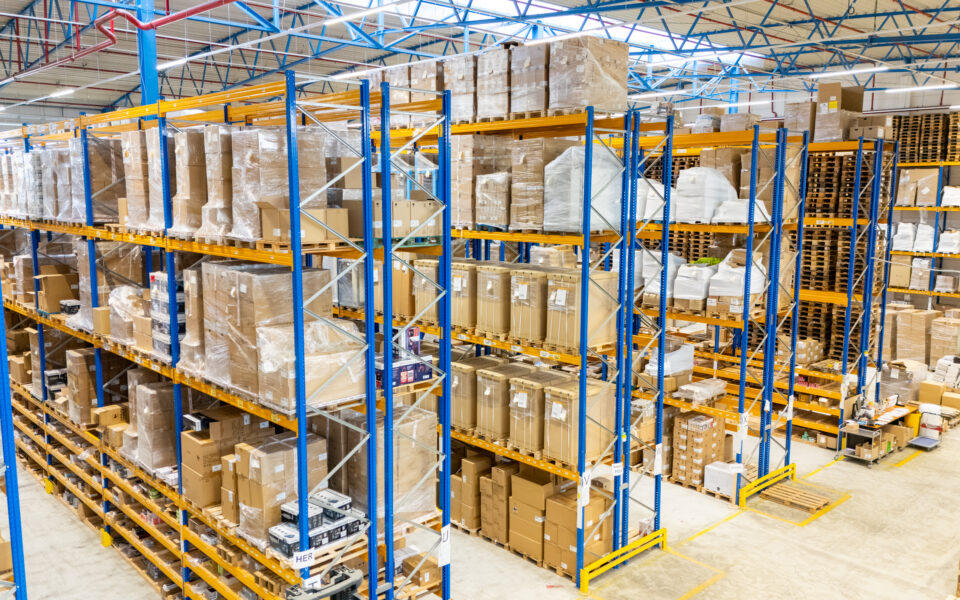
Behind every successful e-commerce logistics is a well-functioning warehouse. It’s not just a place to store goods – it’s the operations centre through which every order passes.
Modern Category A warehouses include:
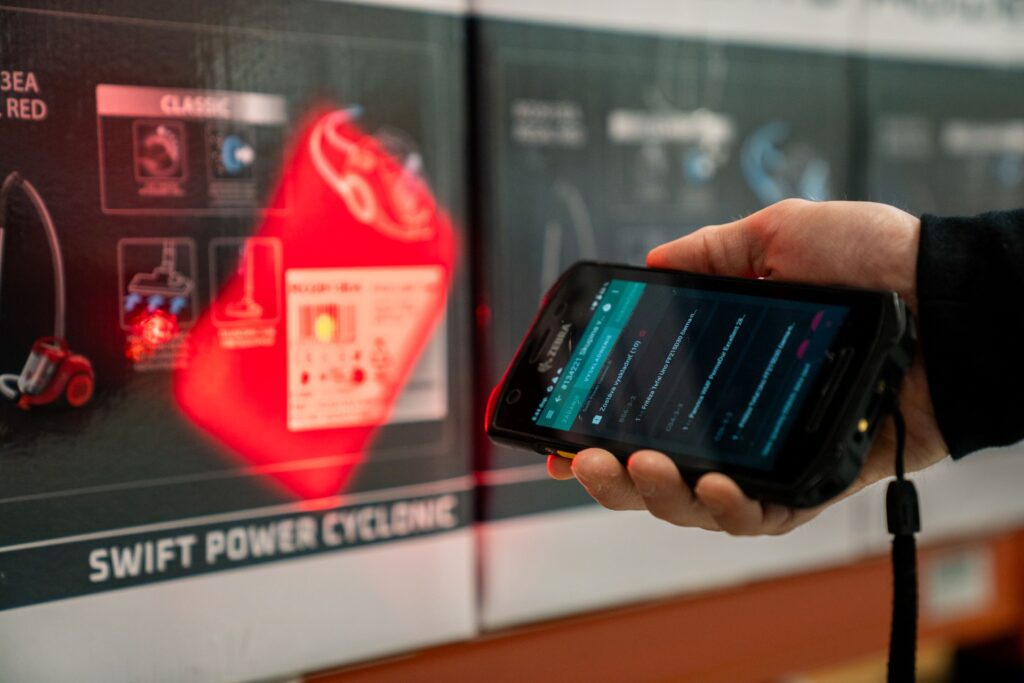
– WMS (Warehouse Management System) – software that manages the movement of each piece of goods in real time. It lets you know what’s in stock, where it’s sitting and how much is going out today.
– Automated packaging – high-speed packaging lines handle thousands of packages per hour, minimizing packaging volume and errors.
– Cross-docking – goods move through the warehouse without permanent storage, reducing delivery time and costs.
Having your own warehouse is an in-house solution for most e-commerce stores in the beginning. However, when orders increase and capacity is not enough, it is time to consider outsourcing.
What does a comprehensive 3PL logistics service include?
3PL (Third-Party Logistics) is a model in which a company outsources logistics operations to an external partner. It’s not just renting a warehouse – a professional 3PL partner covers the entire logistics cycle:
– Receipt of goods into stock – including checking quantities, quality and EAN codes, receipt of atypical materials without codes,
– Storage – in modern BREEAM-certified category A premises,
– Kitting and co-packing – assembling service packages, multipacks, stikering, labelling,
– Packaging – automatic and manual, with the possibility of branding packaging,
– Dispatch – several times a day with flexible cut-off time,
– Transportation – favorable prices due to the volume of shipments (DPD, GLS, Packeta, PPL and others),
– Distribution – B2B and B2C within SK, CZ and HU,
– Reverse logistics – returns and claims management,
– Customs services – for international shipments,
– Recycling – certified ecological disposal of packaging.
A full overview of NAUT Group’s logistics services can be found here.
How to choose the right logistics partner?
Choosing a logistics partner is a strategic decision. Here are some questions you should ask yourself before signing a contract:
1. Coverage and capacity
Where are his warehouses? For companies selling on the Slovak and Czech markets, a partner with operations in both countries (and ideally also in Hungary) is ideal. Warehouse capacity must be able to handle not only normal volumes, but also seasonal peaks.
2. Technological equipment
Does the partner have its own WMS system with real-time inventory overview? Can it integrate with your e-shop via API? Transparency in data is now a requirement, not a bonus. Learn more about NAUT Group’s logistics technologies.
3. Experience and references
How many years has it been on the market? Who are its clients? A reference from a global brand says more than a marketing text.
4. Price transparency
It pays to have a clear quote on the table, not a guide number. A good centre can prepare an individual quote for you based on your real data.
5. Ecological commitment
Sustainability is not just a trend. Customers are increasingly looking at how companies treat the environment. A warehouse with BREEAM certification and carbon neutrality plans can be your competitive advantage too.
Logistics as the foundation on which your business is built
Logistics in short is not just about transport and storage. It’s the silent engine of any successful business – ensuring that goods and information flow smoothly, customers are happy and operations run without unnecessary downtime.
For e-shops, one simple rule applies: the better the logistics, the happier the customers and the stronger the growth. And this applies equally to a small seasonal e-shop as it does to an established brand expanding into new markets.
If you are looking for a partner who can take care of the entire logistics cycle – from stocking to delivery – take a look at our logistics services or contact us for a no-obligation consultation.
Related reading: How does sustainable warehousing and fulfillment work?
Other articles from the category
Logistics Outsourcing: 5 Signs It’s Time for a 3PL, and How to Choose the Right Partner

NAUT Group: we understand our clients’ needs and deliver practical solutions