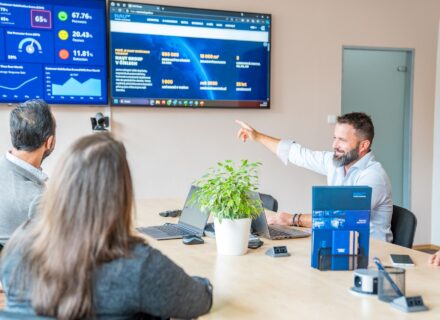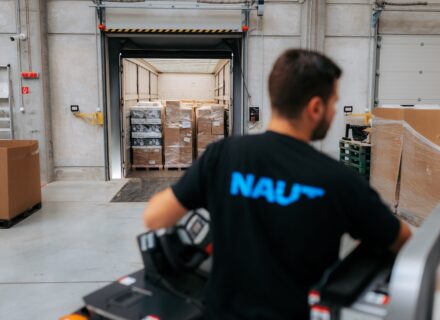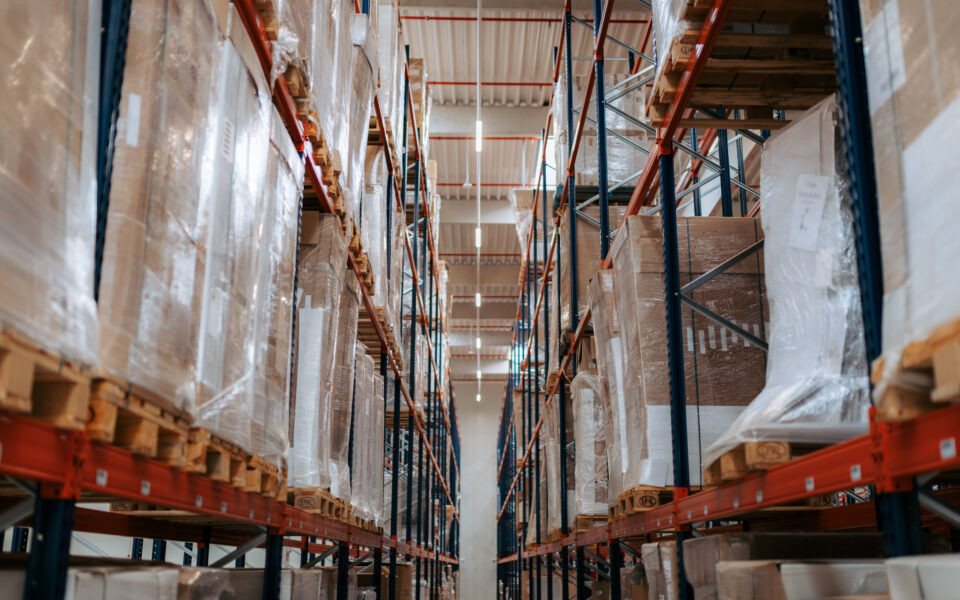

Each service serves a completely different purpose, but at the same time they are all essential to the proper functioning of the whole, this is the complexity we speak of and are proud of
says Petr Nejedlý, CEO of Naut Group
Let’s start by introducing the company and its activities. How did the name NAUT come about?
We have been a supplier of merchandising services on the Czech and Slovak markets for a long time. With the gradual development of the market we have expanded our offer to include synergistic services such as outsourcing of sales representatives, data collection, POSM management, logistics, e-commerce. However, we were still perceived on the market as a “merchandising agency” and we had a different name in each market.
That’s why we decided to make a major change in 2021. We approached Braň Burák, an expert in brand building and marketing, who has successful projects under his belt, for example, he was at the birth of the Rajec brand and took it to the leader of bottled water in Slovakia. Our goal was to create a strong, unified brand that covers all three segments of the business, where we operate from retail services, through warehousing and logistics to e-commerce.
We were looking for a name that was confident, memorable and easy to pronounce. The process of creating the brand made us realize our unique ability – perspective.
Naut is originally Latin for sailor, at that time it was mainly a man – an explorer who sailed on a ship to unknown lands. A daring explorer = today figuratively an innovator, a man with insight – he saw the world from a different perspective than ordinary landlubbers – he travelled beyond the horizon, he knew and knew more. All of these qualities personify what NAUT was and represents today.
You’re offering to take care of everything that’s not their core business. What does the offer include?
NAUT GROUP is dedicated to sales support in all areas, i.e. retail (outsourcing of sales representatives, data collection, POSM management, mystery shopping, merchandising).
Warehousing and logistics (storage of materials and goods, B2B and B2C distribution, truck, pallet and parcel transport, packaging and assembly, complete fulfillment, customs services, reverse logistics, recycling, on-line stock management). E-commerce (architecture and process design, development, expert integration into key systems: ERP, SAP, CRM, WMS, project management, reporting, back office, help desk, complete ERP solutions, effective fulfillment strategies, marketing and SEO solutions, FIPS 140-2 compliant system security, PLA (Product Listing Ads) optimization for excellent visibility, penetration testing, server security).
How do retail, e-commerce and logistics services differ from each other?
In retail, we focus on optimizing the presentation and improving the visibility of products and effective inventory management at the point of sale. In e-commerce, we focus on the same, but in an online environment. Our services cover the integration of our customers’ systems with the online environment, the optimization of e-shop and marketing activities as well as the improvement of e-commerce logistics processes. In logistics, we focus on efficient warehousing, distribution of goods and optimization of shipping processes.

Are there any trends in the use of outsourced services over time?
Certainly, 5 years ago, for example, the issue of outsourcing in the area of e-commerce and DTC (direct to consumer) was completely undescribed, but today it is one of our main areas of growth. Similarly, in the area of merchandising, i.e. properly speaking simple replenishment, we are seeing a gradual shift away from this additional investment in sales support towards actual support in the form of Smart Check or just checking KPI’s. The area of logistics, both merchandise, POSM management and e-commerce fulfillment is our current biggest challenge. In logistics, the main motivation for outsourcing in the past has been to reduce costs and increase operational efficiency to enable companies to avoid heavy investments in infrastructure and technology. Today, cost efficiency remains important, but other customer needs and expectations have changed. The focus is on flexibility, speed and the ability to adapt to a rapidly changing market environment and customer requirements. Demand for sustainability and green solutions is increasing, reflecting a change in the company’s values and priorities.
Do companies rely on outsourcing mainly for economic or personnel reasons?
Sometimes it is hard to look in the mirror of the so-called truth in the eyes, but yes, the main reasons are economic… Logically, if for example in logistics and fulfillment we deal with thousands of shipments, we logically have a better price that we are able to project to our clients. In development and IT solutions, it’s about quality people that both corporate and local companies (our clients) can’t afford to pay. It’s with these people that we bring cutting edge solutions to our customers.
You also offer outsourcing of sales representatives or brand ambassadors. How do marketers use this service?
As part of our service provision in the retail sector, we appreciate the opportunity to offer our clients the outsourcing of sales representatives and brand ambassadors. This approach represents a step towards the integration of personalised marketing strategies and HR, adding value not only in sales but also in brand building and presentation. Unlike the traditional staffing model, we provide a comprehensive business service. This includes not only building and managing teams of sales reps, but also equipping them with a full range of work tools – from cars to mobile phones to ordering systems, including HR agendas. This approach allows us to take full responsibility for achieving set KPI’s, ensuring that our clients’ investments deliver measurable results.
One of the services you provide is data collection and evaluation. How willing are companies to provide their data to a third party?
We focus mainly on so-called visible data. This is data that we are able to record via photographs using AI image recognition technology or by using our software directly when scanning EAN codes on shelves and checkout areas. We are able to report data such as Shelf Share, Promo Share, Price Track etc. to clients. This information, combined with data collected from chains or sales data companies, allows us to provide clients with a comprehensive view of opportunities in the marketplace and in-store.
One of the threats that companies are concerned about is cyber-attacks. Do you feel these concerns when dealing with clients?
Yes, especially in the area of DTC and IT development, for example for tobacco companies, this is one of the very critical topics that we have managed to turn into our advantage, and that is just the high demand for quality security of the data we work with, for example the FIPS 140-2 standard.
What guarantees do you provide to companies when using outsourced services?
This varies from area to area, for example in logistics these safeguards are already fairly well established and well known. In IT, it’s about setting SLAs and in retail services it’s about well clarified expectations versus market opportunities, all backed up by data. We are fortunate, or rather the track record is such that we practically don’t have to resort to applying guarantees.
Any news coming up?
In retail, we are seeing a trend away from traditional merchandising and teaching clients to use other, cheaper tools to control HM/SM and KPIs such as OOS, HQP executions, etc. In IT development and E-COMM outsourcing, running a quality e-commerce store requires a comprehensive approach and careful management. Taylor-made e-commerce solutions bring the flexibility and personalization that is essential for success today. Integration with ERP and WMS systems ensures smooth operation and optimization of warehouse processes, which is essential for proper logistics and delivery. Processing user data in the CRM system enables a deeper understanding of customer preferences and behaviour, which is the basis for creating targeted marketing strategies and offers. Regular editing of the website content in the CMS system is essential to keep it up-to-date and attractive to customers, while also having a key impact on SEO optimization. The e-commerce system must work effectively with SMS gateways, voicebots and email automation to ensure fast and accurate communication with clients. It is imperative to constantly keep up with new technological trends and innovations to stay competitive and stay at the forefront of the market. In logistics, this is downstream fulfillment and POSM management.