
Monday morning, 8:00 a.m. The phone rings; a customer is calling because his order hasn’t arrived, even though the system shows it as “shipped.” The warehouse manager runs between the shelves, looking for a package that could be anywhere. A warehouse worker spent twenty minutes searching for a single box because “it has to be here somewhere.” Meanwhile, more orders are piling up. By lunchtime, there are three more complaints. This isn’t an exceptional day—it’s the daily reality of a warehouse without a functional WMS system.
A Warehouse Management System, or WMS for short, is software that turns chaos into order. It assigns each item a precise location in the warehouse, provides a clear process for every order, and gives every manager a real-time overview. If your e-shop is growing and your warehouse is increasingly holding you back instead of helping you move forward, this article is just for you.
What is a WMS, and what exactly does it manage in a warehouse?
WMS (Warehouse Management System) is a software solution for managing all warehouse operations in real time. It’s not just a record-keeping tool—it’s the brain of the entire warehouse, coordinating the movement of goods from the moment they arrive at the loading dock until they’re shipped out to the customer.
Specifically, the WMS controls:
- Goods Receipt – recording each item, verifying quantities, assigning a stock location,
- Inventory tracking – the exact location of each SKU in the warehouse (shelf, bin, lot, expiration date),
- Picking – instructions for warehouse workers on how to pick orders in the optimal order,
- Packaging and order fulfillment – checking the contents of the package before shipment,
- Shipping – generating shipping labels, assigning carriers, cut-off times,
- Inventory – an ongoing or periodic count of inventory without the need to halt operations.
A WMS sits at the intersection of the e-commerce system and physical warehouse operations. It is a layer that converts digital orders into precise physical actions and, conversely, feeds the physical inventory status back into the digital world.
WMS vs. ERP – What’s the Difference?
Both acronyms sound similar, but they cover very different areas. ERP (Enterprise Resource Planning) is a system for the entire company, covering accounting, HR, purchasing, sales, and many other processes. WMS focuses exclusively on the warehouse, but it does so in depth, with a level of precision and granularity that an ERP warehouse module cannot provide.
Most medium-sized companies use both: an ERP system for business management and a WMS for warehouse management. These systems exchange data via an API—an order from the ERP system is sent to the WMS as a picking instruction, and the WMS sends back a shipping confirmation.
Five Modules That Make WMS a True Management Tool
A modern warehouse management system is not a monolithic program. It consists of modules, each of which handles a specific phase of the warehouse process. Here are five key ones:
Receiving and Stocking
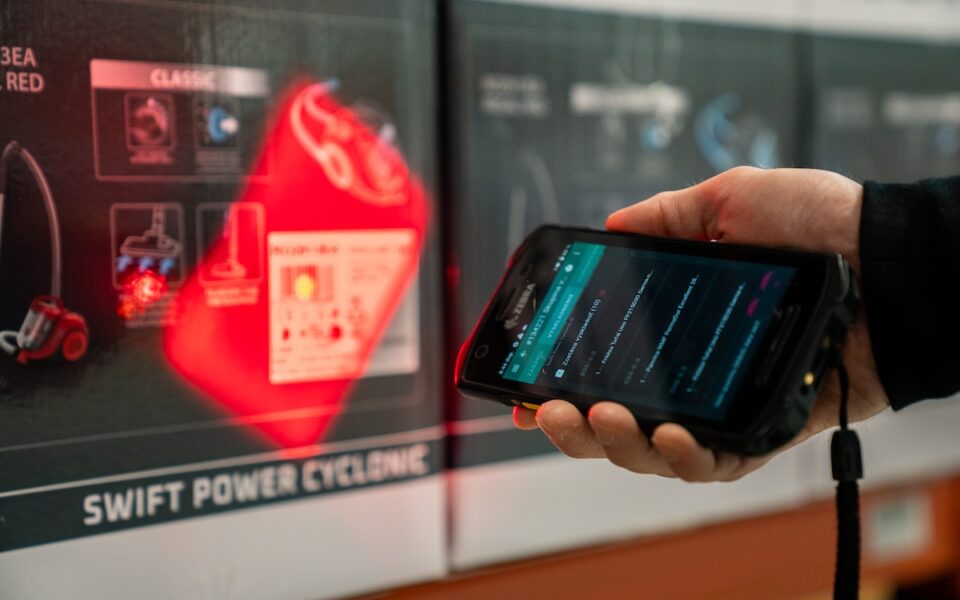
The goods arrive at the loading dock, and the first critical step begins. The WMS system receives a notification from the supplier, and a warehouse worker using a handheld scanner (or tablet) scans each item (barcode, EAN, QR code). The system checks the quantity against the order, records any discrepancies, creates photographic documentation of damaged items, and assigns each item to a specific storage location.
The result: no goods “somewhere in the warehouse”; every item has a precise address from the very first second.
Real-Time Inventory Management
This is the core of any good WMS. The system tracks the status of each SKU in real time—not only the total quantity, but also the breakdown by batch, expiration date, location, and status (available, reserved, quarantine). It automatically applies FIFO (First In, First Out) or FEFO (First Expired, First Out) rotation, which is critical, for example, for food, cosmetics, or pharmaceuticals.
Set your minimum stock levels, and the WMS will alert you when you approach that threshold. No surprises, no stockouts without warning.
Order Picking and Fulfillment
When an order comes in, the WMS generates an optimized picking list for the warehouse worker, and algorithms plan the route through the warehouse to minimize unnecessary walking. Instructions can be sent to a paper printout, a tablet, a voice headset (voice picking), or directly to the forklift’s display.
The system monitors order picking in real time. If a warehouse worker scans the wrong code, they receive an immediate notification. Once the order is complete, a final check is performed, and the package is shipped only if the contents match the order.
Shipping and Shipping Labels
WMS can work with multiple carriers simultaneously. Based on the rules you set (weight, destination country, customer’s preferred carrier), it automatically selects the correct carrier, generates a shipping label, and enters the tracking number. The system also monitors cutoff times: orders received before the cutoff are shipped the same day; others are shipped the next morning.
Reporting and Analytics
WMS is also a source of valuable data. The manager can view an overview of inventory movements for any given period, picking error rates, individual employee productivity, and order processing costs right from the dashboard. Customer reports allow e-commerce business owners to monitor their inventory status at any time and from anywhere, whether they’re in the office or on vacation.
Excel, spreadsheets, paper—why aren’t they enough when you have more than 100 orders a month?
An Excel spreadsheet. A paper list on the wall. “I know where it is; I remember.” This works as long as you have dozens of orders a month and two people in the warehouse. But what about hundreds? Or thousands?
The evidence is clear: 65% of retailers struggle to track inventory in the supply chain (Wakefield Research, 2023). And 73% struggle with forecasting demand (Wakefield Research, 2023). These aren’t small businesses with disorganized drawers—they’re established companies that simply don’t have the right tools.
Specific problems that arise when a WMS is missing:
- Incorrect orders – the warehouse worker remembered the wrong SKU, and the customer receives the wrong product. Returns, complaints, loss of trust.
- Duplicate inventory —the same items in two different locations in the warehouse; the records show a different quantity than the actual physical count. The inventory count takes days.
- Out-of-stock items without warning —the product runs out, but the online store keeps selling it for hours. 37% of online shoppers will buy from a competitor when they encounter an “out of stock” message (Shopify, 2021). Every “sold out” situation isn’t just a lost order—it’s a lost customer.
- Inability to scale —during Black Friday or seasonal peaks, a system without a WMS crashes. Errors increase exponentially with volume.
- Zero visibility for the customer —you can’t tell them exactly where their order is because your system simply doesn’t track it.
According to McKinsey (2023), modern AI solutions integrated into WMS go even further: AI has reduced logistics costs by 15%, inventory by 35%, and increased customer service levels by 65%. However, these results assume that you have basic digitalization in place—that is, a functional WMS system as a foundation.
If you’re thinking about logistics in more depth, be sure to read our article as well What is logistics? Meaning, types and why it is crucial for e-commerce .
Connecting WMS to Your Online Store: How Does the Integration Work in Practice?
A WMS system without a connection to an e-shop is just a sophisticated inventory management system. Its true power comes into play when the WMS is connected to your sales channel via an API (Application Programming Interface).
The order process then looks like this:
- The customer clicks “Order” in your online store (Shopify, WooCommerce, Shoptet, or any other platform).
- The order is automatically transferred to the WMS in real time, without any manual intervention.
- The WMS generates a picking list and allocates inventory.
- After shipment, WMS sends the tracking number back to the online store.
- The customer will receive an automated email with a link to track the shipment.
The entire process takes place without anyone having to manually enter orders into another system. No copy-pasting, no transcription errors, no delays.
Multichannel – One WMS for All Sales Channels
Modern e-commerce stores sell across multiple channels simultaneously: their own online store, marketplaces (Alza, Mall, Amazon), B2B wholesale, and brick-and-mortar stores. Without a WMS, inventory synchronization is a nightmare. With a WMS, the status of each SKU is automatically synchronized across all channels; if an item is sold on Alza, the online store immediately removes it from available inventory.
The result: no sales of something that doesn’t physically exist. No manual updates. And satisfied customers across every channel.
Real-time Inventory as a Competitive Advantage
Integrating the WMS with your online store also allows you to display accurate availability information to customers. “3 items left” isn’t just a marketing gimmick—it’s the actual status from the warehouse management system, which is updated with every movement of goods. This helps customers make purchasing decisions faster, and you minimize complaints about out-of-stock items.
An in-house WMS or a WMS as part of fulfillment—which is cheaper?
This raises a question that every growing e-commerce store asks itself: Should I purchase my own WMS software, or should I use WMS as part of an outsourced fulfillment service?
The answer depends on your situation, but the numbers speak for themselves:
| Aspect | In-House WMS | WMS in Fulfillment (3PL) |
| Initial Investment | 5,000 – 50,000+ € (license or development) | None – included in the price of the service |
| Implementation | 3–12 months + IT team | In a few weeks, the partner will handle the integration |
| Maintenance and Updates | In-house IT department or a vendor | The fulfillment partner will handle this |
| Staff Training | At your expense | The fulfillment partner will handle this |
| Flexibility for Growth | Subject to the terms of the license | It scales automatically with volume |
| Process Control | Full – set it yourself | Partial – according to the partner’s standards |
| Suitable for | Large companies with their own warehouses and IT systems | Online stores, companies without IT resources, quick start |
In-house WMS software makes sense if you have your own warehouse, complex requirements (specific technology, regulated goods, unique processes), and an IT team capable of implementing and maintaining the system. For most e-commerce stores, however, working with a fulfillment partner is much more efficient: you’ll save on investment, launch faster, and gain access to professional WMS software that you couldn’t afford on your own.
You can read more about how logistics outsourcing works in the article What Is Fulfillment? Definition, Translation, and Basic Principles .
How WMS Works in Practice – An Example from the NAUT Group
Theory is one thing—see how it works in a real-world operating environment.
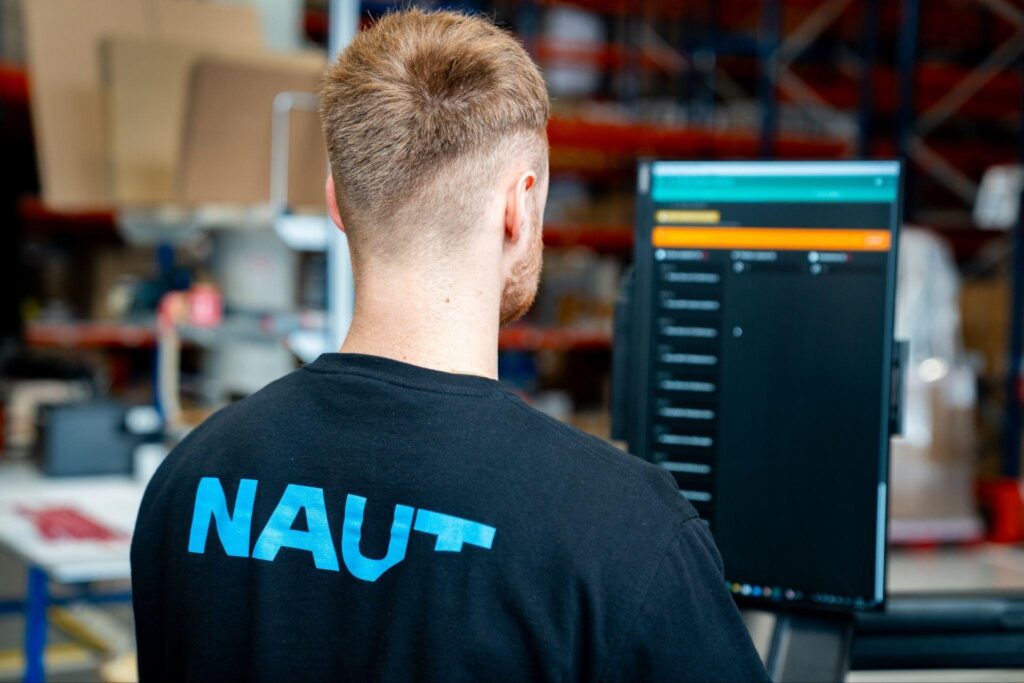
The NAUT Group has developed its own WMS system called NAUT Middleware®. This is not an off-the-shelf solution; it is a system tailored to the logistics operations that NAUT performs daily for its clients. NAUT Middleware® coordinates the movement of goods across three logistics centers— Prague, Piešťany, and Budapest —with a total of 18,000 m² of warehouse space.
The system processes more than 886,000 shipments annually, of which 584,000 are B2B and 302,000 are B2C. Each shipment is backed by accurate record-keeping, tracking, and automated instructions for warehouse staff.
Online Stock Management Tool®: Track inventory on your mobile device, anytime
One of the key features that NAUT Group clients value most is the Online Stock Management Tool®, a proprietary tool for real-time inventory tracking. An e-shop manager doesn’t have to call the warehouse to find out how many units of a particular product are left. They simply open the app to see the exact stock levels, inventory movements, and transaction history—whether from a computer, tablet, or smartphone, in the office or on vacation.
This type of visibility is what sets a modern warehouse management system apart from traditional warehouse management methods. Not a daily report, but a live, real-time overview.
Clients who trust this system
With 24 years of experience in logistics and fulfillment, the NAUT Group manages inventory for global brands such as Bosch, Red Bull, Groupe SEB, Mars, Mondelez, BAT, Mattoni, Rauch, Fiskars, and other major clients. For each client, NAUT Middleware® serves as the backbone, ensuring that the right goods are in the right place at the right time.
If you’re interested in learning more about NAUT Group’s technological solutions, check out the overview of technologies on the logistics page.
A WMS System as the Foundation for a Growing E-Commerce Store
A WMS isn’t just an IT project—it’s a strategic tool that determines whether your warehouse will be a hindrance or a driver of growth. With the right warehouse management system, you’ll stop worrying about where each item is and start focusing on what truly drives your business forward.
If you operate your own warehouse and are looking for a way to digitize it, investing in WMS software or a warehouse management system will pay for itself quickly through lower error rates, faster shipping, and more satisfied customers. However, if you’re looking for a way to spend less time on logistics and more time on sales, a fulfillment partner with its own WMS is a more efficient choice—and you won’t have to invest a single euro in technology.
Check out our logistics services, read about our pricing, or contact us directly for a no-obligation consultation. We’d be happy to show you how NAUT Middleware® and the Online Stock Management Tool® work in practice for your specific type of merchandise and order volume.
Related reading: What is logistics? Meaning, types and why it is crucial for e-commerce | What Is Fulfillment? Definition, Translation, and Basic Principles