
Fulfillment. You’re hearing about it more and more often: at e-commerce conferences, in sales pitches from logistics companies, and in conversations with e-shop owners. But what does this term actually mean? And why has it become one of the key terms in modern online retail?
In this article, we’ll explain what fulfillment is, where it comes from, how the entire process works, and how it differs from standard logistics. If you’re looking for a practical guide on who can benefit from fulfillment and when to start using it, keep reading.
What does “fulfillment” mean, and how is this term translated?
The word “fulfillment” comes from English, where it basically means “fulfillment” or “fulfilling, ” such as fulfilling a promise or meeting expectations. In the context of e-commerce and logistics, it has taken on a specific technical meaning.
There is no established Czech term that adequately captures the meaning of the word “fulfillment.” For this reason, the English term is used directly in a business context. The most common definitions describe it as:
- Complete logistics outsourcing —that is, entrusting the entire logistics process to an external partner,
- Comprehensive order processing —from order receipt through warehousing to delivery to the customer,
- third-party logistics (3PL) – logistics services provided by a third party on behalf of an online store.
Simply put: when a customer orders a product from your online store and the package is delivered by a fulfillment center that isn’t yours, that’s fulfillment.
Where does the term “fulfillment” come from?
The origins of the logistics center sector date back to the 19th century, when the first distribution warehouses and delivery companies were established. At that time, however, the term used was “supply services,” not “fulfillment.”
The term “order fulfillment” became established with the advent of the Internet and e-commerce in the 1990s. Emerging online retailers found that managing inventory, packaging, and delivery across multiple markets at once was extremely challenging. They needed a partner who could handle this for them, and that is how the fulfillment industry was born.
The global market for e-commerce logistics services is currently estimated at $123.7 billion (Capital One Shopping, 2025) and is projected to exceed $272 billion by 2030.
How does the entire fulfillment process work, step by step?
Fulfillment isn’t just a single “ship package” button. It’s a chain of interconnected steps, each of which must work perfectly so that the customer receives their order on time and in good condition.
1. Loading of Goods
It all starts when your goods arrive at your fulfillment partner’s warehouse. Each item is recorded in the WMS (Warehouse Management System)—ideally with an EAN code, photo documentation, and its exact location in the warehouse. A good fulfillment center can even accept non-standard items without barcodes.
From this point on, you’ll have a real-time overview of every item, from anywhere, through the online application.
2. Storage
The merchandise is stored in appropriately sized facilities, ready for order. Our modern Category A warehouses feature shelving for small items (cosmetics, clothing, dietary supplements) as well as space for pallets of large products (appliances, furniture, electronics).
3. Picking
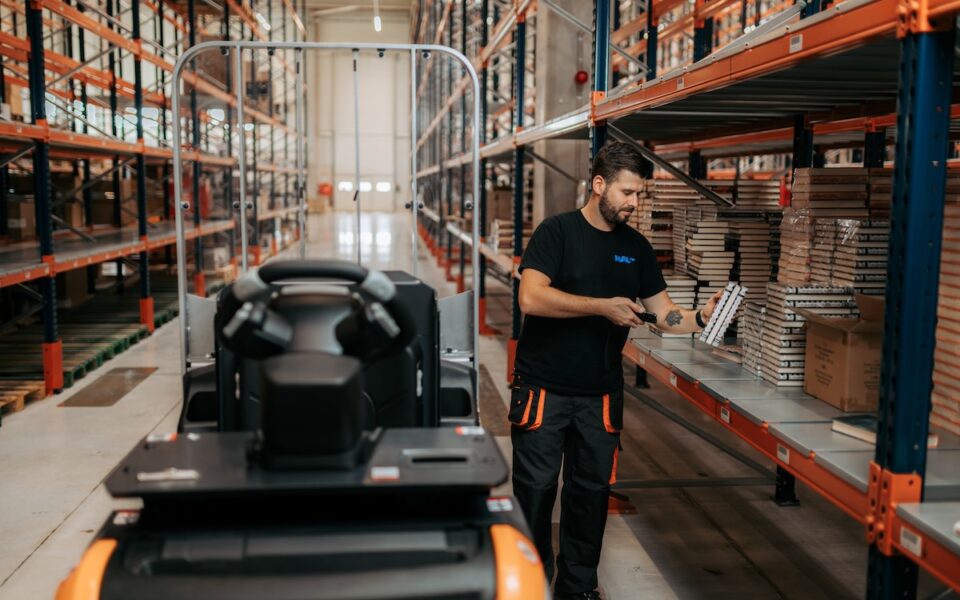
As soon as a customer places an order, the system automatically generates instructions for the warehouse worker. The warehouse worker then picks the correct items from the correct shelves, following the instructions in the system exactly.
4. Assembly and Packaging
The selected items will be assembled and packaged.
This phase also includes co-packing —assembling multipacks and service packages, applying labels, and repackaging for different language versions of the market.
5. Expedition
Packaged shipments are sent out several times a day. The “cut-off time” is the last hour by which we ship orders received that same day.
6. Transportation
The logistics center works with several carriers (DPD, GLS, Packeta, PPL, and others). Thanks to the large volume of shipments, it secures more favorable rates than you could negotiate on your own as an individual e-shop. In addition, customers can choose the delivery method that suits them best.
7. Back Office
The back office serves as the administrative backbone of fulfillment. It encompasses all the processes that customers don’t see but that are essential for the smooth processing of orders. These include, for example, inventory management, invoicing, returns tracking, reporting, and communication with carriers.
Thanks to an efficiently configured back office, online stores have a real-time overview of order status and inventory levels. This helps prevent errors, speeds up order fulfillment, and simplifies the day-to-day operations of an online store.
8. Reverse Logistics – Returns and Complaints
Returns are an integral part of e-commerce. Fulfillment not only handles this for you, but also manages the entire process professionally. Returned items arrive back at the warehouse, where a staff member inspects them, takes photos, logs them, and—based on your instructions—either restocks them or sends them to you for further review.
How does fulfillment differ from standard logistics?
The terms “fulfillment” and “logistics” are sometimes used interchangeably, but they are not the same thing.
Logistics is a broad term. It encompasses the entire flow of goods and information within the supply chain, including procurement, production, and transportation. You can find out more about logistics and its different types in our comprehensive guide.
Fulfillment is a more specific term. It refers to a fully outsourced process, from stocking inventory on your behalf to delivering it to the customer. It is third-party logistics (3PL) as applied to e-commerce.
| Aspect | In-House Logistics | Logistics (3PL) |
| Warehouse | Owned or Rented | Partner’s Shared Warehouse |
| Costs | Fixed costs (rent, employees, technology) | Variable (based on volume) |
| Scalability | Limited by space and capacity | Flexible, grows with you |
| WMS Technology | You’ll have to take care of that yourself | Part of the service |
| Seasonal fluctuations | Risk of Capacity Overload | Automatically absorbed |
| Expansion into New Markets | We need a new warehouse and a team | You will make use of existing centers |
How is the price of fulfillment determined? What factors make up the final price?
The price of fulfillment services is always determined on a case-by-case basis. It depends on the size and weight of the goods, the number of SKUs, the volume of orders, specific packaging requirements, and the geographic scope of delivery.
Usually, you pay for several components:
- Goods Receipt – one-time fee for stocking a new batch,
- Storage – you pay only for the pallet spaces you use (not for the entire warehouse),
- Pick & pack – the cost of picking and packing each order,
- Shipping and Transportation – carrier’s price, including the center’s markup,
- Additional Services – Custom Packaging, Cash on Delivery, Returns, Customs Declarations.
It’s worth getting a customized quote based on your specific information. Most centers take an individualized approach to their clients, and most online stores find that an external solution is more cost-effective than what they’ve been using so far.
Fulfillment vs. In-House Logistics: When Is It Time for a Change?
In-house logistics makes sense as long as you have it under control. Signs that it’s time to consider outsourcing logistics:
- You spend hours every day on packaging instead of product development and marketing.
- Seasonal peaks put an excessive strain on you; you can’t keep up, and mistakes happen.
- Do you want to expand and sell in Slovakia, Hungary, or even further afield without having to open another warehouse?
- Customers are complaining about delivery times; you need a higher level of automation.
- Your warehouse isn’t big enough, and investing in new space would tie up capital that is needed elsewhere.
If at least two of these points sound familiar to you, outsourcing logistics is probably the right move. According to surveys, 60% of online retailers currently outsource at least part of their logistics, and the share of those outsourcing their entire fulfillment process is expected to increase by 50% in the coming years (Capital One Shopping, 2025).
Fulfillment as a Strategic Decision, Not Just a Compromise
Fulfillment isn’t just about getting rid of packaging. It’s a strategic decision that gives you time to grow, flexibility to adapt to seasonal demand, and the opportunity to expand without having to build your own logistics infrastructure.
The right fulfillment partner doesn’t just handle your shipments—it focuses on the customer experience, which is crucial for repeat business today. And the numbers show that customers who receive their orders quickly, in perfect condition, and with an easy return process come back.
If you’re interested in how fulfillment works in practice at NAUT GROUP and who it’s suitable for, read our practical guide: Fulfillment – Who It’s Suitable For and How It Works.
Or, if you’re ready to take the next step, check out our logistics services and contact us for a no-obligation consultation.
More articles on this topic: What Is Logistics? Definition, Types, and Why It Is Essential for E-Commerce .
Other articles from the category

We are experiencing a boom in trends for employees. How not to forget the clients?
What is logistics? Meaning, types and why it is crucial for e-commerce