
It’s Sunday evening. While your competitors are planning next week’s campaigns, analyzing data, or simply relaxing, you’re taping up another box. And then another. And another. Your basement warehouse is bursting at the seams, your neighbors think you’re running a shipping center, and your marketing plan for the third quarter is still just a Google Doc with a single sentence. This isn’t a joke—it’s the reality for hundreds of e-shop owners who, every month, put off answering the question just a little longer: when is the right time to outsource logistics?
In this guide, you’ll find a specific answer. We’ll explain the difference between 1PL through 4PL models, highlight 5 signs that your business has outgrown its logistics capabilities, and provide you with 7 criteria to help you distinguish a truly good 3PL partner from an average one.
What Logistics Outsourcing Really Means—1PL, 2PL, 3PL, 4PL
When we talk about logistics outsourcing, we mean handing over part or all of the logistics process to an external partner. But not all outsourcing is the same. The industry recognizes four basic models that differ in the degree of the external partner’s involvement.
| Model | Who handles logistics? | What does this mean in practice? | For whom |
| 1PL | The company itself | Own transportation, own warehouse, own staff | Startup e-commerce stores, local manufacturers |
| 2PL | Partially outsourced | Rented warehouse or freight forwarder, but management remains with the company | Growing e-commerce stores with a single marketplace |
| 3PL | External partner | The entire process—receiving, warehousing, packaging, and shipping—is handled by a 3PL partner | E-commerce stores and brands looking to grow and expand |
| 4PL | Meta-coordinator | A single partner manages multiple 3PL providers simultaneously | Large corporations with a global network |
NAUT GROUP operates as both a 3PL and 4PL partner —it handles all your logistics operations for you. You don’t have to worry about warehousing, staff, technology, or contracts with carriers. You can focus on sales and your product. You can find more information about NAUT Group’s logistics services on the homepage.
Most companies go through a natural evolution: they start with 1PL, move on to 2PL, and once they reach a certain volume and have certain ambitions, they opt for 3PL. When is the right time?
Five Signs That Your Business Has Outgrown In-House Logistics
According to surveys, 60% of online retailers currently outsource logistics at least partially, and the share of those outsourcing the entire fulfillment process is projected to grow by 50% over the next 3–5 years (Capital One Shopping, 2025). This is no coincidence; it’s a response to specific pain points that recur in thousands of stories.
1. You’re spending time on logistics that should be devoted to your business
Packaging, receiving goods, handling complaints, coordinating with carriers—each of these tasks sounds trivial. Until you add up the hours. When a founder or manager spends 2–4 hours a day on day-to-day logistics instead of product development, negotiating with suppliers, or marketing, the company stagnates. Outsourcing logistics isn’t about laziness—it’s about allocating your most valuable resources: time and attention.
2. Seasonal spikes are an annual nightmare
Christmas, Black Friday, Easter—every season brings a surge in demand for which you’re not prepared in terms of capacity. You can’t keep up, mistakes are made in orders, customers are dissatisfied, and you have to rush to hire temporary workers—but you can’t properly train them. A good 3PL partner has these fluctuations built into their processes: seasonal spikes three times higher than normal are standard for them, not a crisis.
3. Expansion abroad hits a logistical roadblock
You want to sell in the Czech Republic, Slovakia, Hungary, or beyond, but the thought of a second warehouse, a second team, and a second set of contracts with carriers paralyzes you. NAUT GROUP operates three logistics centers: in Prague, Piešťany, and Budapest. One partnership—three markets. No need to build your own infrastructure.
4. Customers receive their packages late and turn to the competition
Delivery time is a key factor in repeat purchases today. If your warehouse is located on the outskirts of town, far from the carrier’s distribution hub, or if you ship only once a day, customers will notice. Category A logistics centers are strategically located, ship several times a day, and work with multiple carriers (DPD, Packeta, GLS, PPL, WE-DO, PST CLC, GEIS), which means faster delivery at a better price.
5. Logistics costs are rising faster than revenue
Logistics accounts for 10–15% of an e-shop’s total operating costs. When this figure rises despite growing revenue, something isn’t working. In-house logistics is dominated by fixed costs—rent, wages, and technology depreciation—which you pay regardless of volume. The 3PL model is variable: you pay for pallet spaces that are actually occupied and orders that are actually fulfilled. This is a fundamental difference in cash flow management.
What You Get from a 3PL Partner and What You Pay For
One of the most common questions when considering outsourcing is: what exactly does it entail? The answer depends on the partner, but comprehensive 3PL fulfillment covers the entire chain from receiving goods to returns from customers.
In the case of NAUT Group’s logistics services, this specifically means:
- Goods Receiving – inspection, EAN code recording, and photographic documentation of each item received
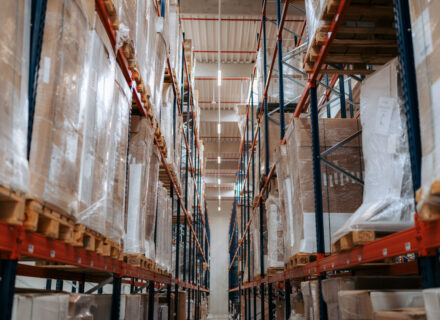
- Warehousing – Category A warehouses with BREEAM Very Good certification (Prague, Piešťany, Budapest), 18,000 m² of total space
- Picking and Order Fulfillment – order picking based on real-time instructions from the WMS system
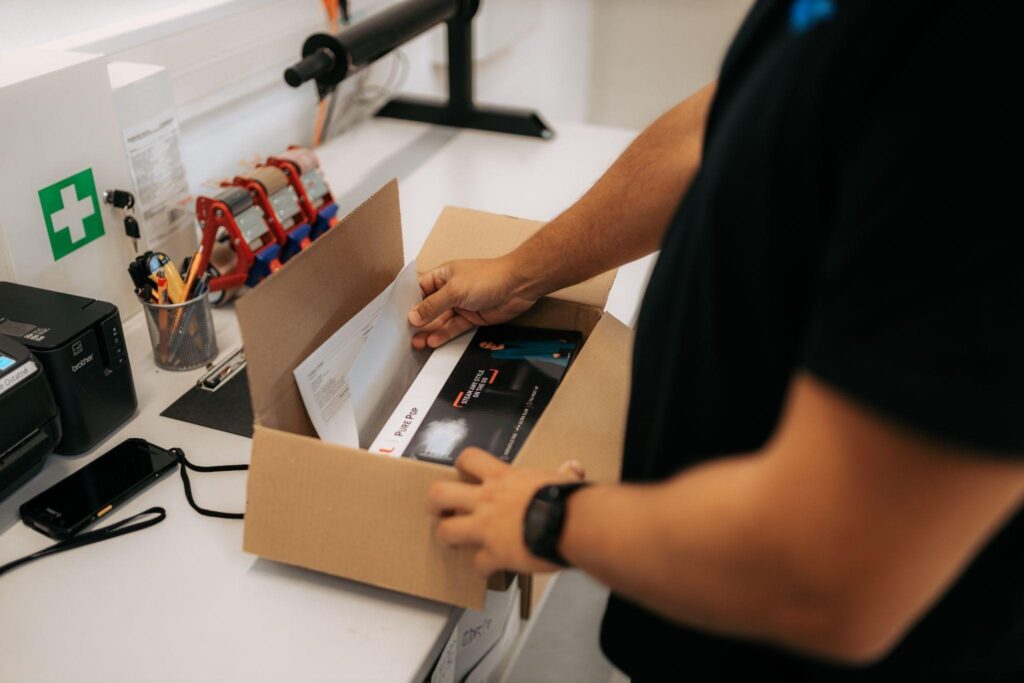
- Packaging – automated (more than 1,000 packages per hour) and manual (branded boxes, special packaging)
- Co-packing – multi-packs, gift sets, labeling, repackaging for different language markets
- Shipping – several times a day, with a clearly defined cutoff time
- B2B and B2C distribution – Slovakia, Czech Republic, Hungary and other European markets
- Reverse logistics – professional handling of returns and complaints
- Customs services – for international shipments outside the EU
- Environmentally Friendly Packaging Disposal – in Compliance with ESG Requirements
This is where NAUT Middleware® comes in—our proprietary WMS system with a real-time overview of inventory status. Customers control it via the Online Stock Management Tool®, accessible from a mobile device anywhere in the world. No phone calls to the warehouse, no guesswork about inventory levels—just accurate, real-time data. You can find out more about NAUT GROUP’s technologies on the page dedicated to WMS solutions.
So what are you paying for? The price consists of several components:
- Goods Receipt – one-time fee for stocking a new shipment
- Storage – monthly fee for occupied pallet spaces (not for the entire warehouse)
- Pick & Pack – fee for each order picked and packed
- Shipping – discounted rates from carriers based on shipment volume
- Additional services – co-packing, cash-on-delivery, reverse logistics, customs declarations.
The final price is always determined on a case-by-case basis and depends on the volume, weight of the goods, number of SKUs, and any special requirements.
Seven Criteria That Distinguish the Right Partner from an Average One
There are several 3PL providers operating in the Central European markets. How can you tell which one will be a truly reliable partner for growth—as opposed to one that makes promises but doesn’t deliver? Here are seven questions you should ask every candidate.
1. Geographic coverage—where are their warehouses physically located?
A warehouse’s location directly affects delivery speed and shipping costs. Ask: “In which countries do you have warehouses, and how far are they from major transportation hubs?” A warehouse in an industrial zone outside the highway network is a disadvantage that the customer will feel with every order.
2. Technology – a proprietary WMS or Excel spreadsheets?
A modern 3PL partner must have its own or a certified WMS system with API integration with your e-shop (Shoptet, Shopify, WooCommerce, Magento…). Ask: “Can I track inventory levels in real time? What reports do I receive automatically?” If the partner hesitates or mentions manually sending spreadsheets, that’s a red flag. You can find more about what to look for in logistics technologies in our overview.
3. Industry Experience—Who Are Their References?
Logistics for the pharmaceutical industry differs from logistics for the fashion industry. Logistics for FMCG requires different processes than logistics for consumer electronics. Ask: “Do you have experience with companies in my industry segment? Can you provide specific references?” Among NAUT GROUP’s clients are, for example , Mars, Groupe SEB, Red Bull, Bosch, Mondelez, BAT, Mattoni, Rauch, and Fiskars— these aren’t just names, but proof of capabilities and processes on par with global brands. Check out NAUT GROUP’s references.
4. Scalability—Can they handle your growth, even if your volume triples?
A good 3PL partner grows with you, not in spite of you. Ask: “What is your maximum volume? How do you handle seasonal peaks? What is your capacity in November and December?” NAUT GROUP processed 886,000 shipments last year—584,000 B2B and 302,000 B2C. This volume is no accident; it’s the result of processes designed for variability.
5. Price Transparency—Clear Calculations, Not “We’ll Work Something Out”
Vague price quotes hide hidden fees that only become apparent on the first invoice. Ask: “Can you provide me with a specific price list detailing all items—receiving, storage per pallet, pick-and-pack per order, shipping, and additional services?” Each item should have a specific price, not a phrase like “depends on volume.”
6. Environmental Commitment—Certifications and Carbon Neutrality Plans
ESG requirements are becoming the standard, not a bonus. Customers and investors are watching them closely. Ask: “What environmental certifications do you have? What are you doing to reduce your carbon footprint?” NAUT GROUP’s logistics centers in Prague, Piešťany, and Budapest are certified to the BREEAM Very Good standard—an international benchmark for sustainable buildings.
7. Communication and Reporting—How do you find out what’s happening with your orders?
Ask yourself: “Do I receive photo documentation of incoming shipments? Do I have access to a live dashboard? Who is my account manager, and how quickly do they respond to issues?” Silent warehouses where you don’t know what’s going on create stress. A good partner gives you a complete overview without you having to actively ask for it.
Red Flags—When Not to Sign a Contract
Just as important as knowing what you’re looking for is knowing how to recognize warning signs. If you encounter any of the following during negotiations with a potential 3PL partner, pay close attention.
- They can’t provide references from your industry. Every warehouse claims it can handle everything. The proof is in the references—and those should be specific, verifiable, and from a similar industry.
- They don’t have their own WMS. If they manage inventory in spreadsheets or in a system you don’t have access to, you’re dependent on their willingness to provide you with data. That’s not a partnership.
- Prices are “approximate” or “negotiable” without specific figures. Transparent pricing is a sign of a mature process setup. Vagueness in the price quote will translate into problems on the invoice.
- High employee turnover. A warehouse where staff changes every three months is a warehouse rife with errors. Ask about the average length of employment for workers.
- No SLA (Service Level Agreement) regarding error rates. If a partner is unwilling to commit in writing to a maximum error rate for order picking, it speaks to their lack of confidence in their own processes.
- You are not allowed to visit the warehouse before signing the contract. Any reputable 3PL partner will invite you for a tour. Refusing this opportunity is a clear red flag.
How Much Does Logistics Outsourcing Cost? Real Numbers
A question everyone wants a straight answer to—but one that doesn’t have a single correct numerical value. The cost of logistics outsourcing depends on several variables: order volume, the size and weight of the goods, the number of SKUs, the geographic scope of delivery, and special packaging requirements.
Nevertheless, it is possible to describe the cost structure that is standard in the industry:
| Folder | How to Record | Note |
| Goods Received | Per pallet / per item | One-time entry upon receipt |
| Storage | Per pallet space / month | You pay only for occupied spaces |
| Pick & Pack | Per order (+ per item) | Includes packaging materials |
| Shipping and transportation | Per shipment based on weight and destination | More favorable rates than direct shipping |
| Reverse logistics | Per processed return case | Return, inspection, restocking |
| Additional services | Customized | Co-packing, labeling, customs clearance |
When is outsourcing more cost-effective than in-house logistics? The break-even point depends on specific figures, but as a general rule of thumb: when the fixed costs of operating your own warehouse (rent, wages, technology) exceed the variable costs of the 3PL model for your volume, outsourcing is cheaper. At the same time, it is more efficient overall—not just cheaper. AI-driven logistics solutions have reduced logistics costs by an average of 15%, inventory by 35%, and customer service costs by 65% (McKinsey, 2023).
For a comparison of in-house versus outsourced logistics, including specific examples, we recommend the article “What Is Logistics?”
How to Take the First Step Toward Outsourcing Logistics
Outsourcing logistics isn’t a decision that’s made overnight, but neither is it one that should be put off indefinitely. Companies that make this decision at the right time will gain something more valuable than cost savings: they’ll regain their focus on what truly drives their business forward.
Over its 24 years in logistics and fulfillment, NAUT GROUP has shipped more than 886,000 packages annually for clients such as Mars, Mondelez, Groupe SEB, BAT, Mattoni, Rauch, Fiskars, and Bosch. Three logistics centers in Prague, Piešťany, and Budapest cover key Central European markets with 18,000 m² of warehouse space and BREEAM Very Good certification.
If you’ve identified at least one of the signs described above, now is the right time to take concrete action:
- View a complete overview of our logistics services
- Request a price quote based on your data
- Or simply contact us for a no-obligation consultation —together, we’ll assess whether outsourcing logistics is the right move for your business and when the best time is to get started
Related reading: